
What is Keyword Research – How to Do Keyword Research for Beginners

Summary
Write Seed keywords → Expand them with tools → Check volume, intent and KD → Create Topics out of them → Create helpful content.
A simple yet powerful process for keyword research. In simple terms, keyword research is the process of finding the right words to get audience.
With this, you will stop guessing keywords and start writing content that actually has a higher chance of ranking rather than random ones.
It helps in:
- Understanding and creating valuable content for your audience.
- Improving your chance of ranking in search engines.
- Building stability over time.
Introduction
This article is part of SEO for Beginners guide.
For every website to rank on search engine you must know how to do keyword research. It is the main pillar from which you start writing and creating the content strategy.
For a beginner, keyword research is the first skill that you should learn and master for better SEO. In this article, you will learn the fundamentals of keyword research with a step-by-step process of doing it.
Check out:
What is SEO? Challenges, Factors affecting ranking and more.
How Search Engines Work: Simplest Breakdown from Crawling to Ranking
What is Keyword Research
Keyword research tells us how to bring traffic to the website.
It is the process of researching and organising the keywords, particularly for our website, that people search on search engines to get information, products, and services.
Keyword research helps us to answer:
- What are people searching for?
- How many people are searching for it?
- Why are they searching (search intent or purpose)?
For example, if you have a salon, keyword research can show you what people are typing into search engines about a salon service:
“hair salon near me”
“women’s haircut”
“men’s haircut”
“keratin treatment”
So instead of guessing what to write, we use real data to plan the content and target the audience.
Why Keyword Research important for SEO

Keyword research is important because it:
- Tells us the right words the audience is using in a particular area for a query.
- Gives you real-time data about the competition for the keywords so that you can use them correctly.
Helps you plan and create the content.
Helps you rank in search engines.
Tells you exactly what is in demand.
Improves site visibility, and you get to know your real audience.
Supports SEO efforts and saves time.
Note: To get ranked, we never believe in writing random content; to target the right audience for your business, we use the words users are typing and plan the content accordingly rather than random stuff.
So, create what audiences are looking for.
Types of Keywords On the Basis of Length
Keyword types based on length:
- Short-Tail Keywords or small keyword
Short-tail keywords contain 1–2 words.Example:
“shoes”
“car”
“jewellery”Hard to rank, but can bring high traffic if the website has higher authority and high-quality content.
- Mid-Tail Keyword or medium keyword
Mid-tail keywords contain 2–4 words more specific than Short-Tail keywords.Examples:
“sport shoes for women”“car under Rs 500000”
“Gold jewellery shop”Have good search volume but are still difficult to rank for a new website.
Long-Tail keywords or Long Keywords.
Long-tail keywords contain more than 4 words and are very specific.
Examples:“best sports shoes for women under Rs 3000”
“Best car for 4 people under Rs 500000 for family”
“Best gold jewellery shop in delhi with low making charges ”
Best for a new website to use long-tail keywords in starting because of low competition and have specific type of visitor,
Characteristics of Keywords
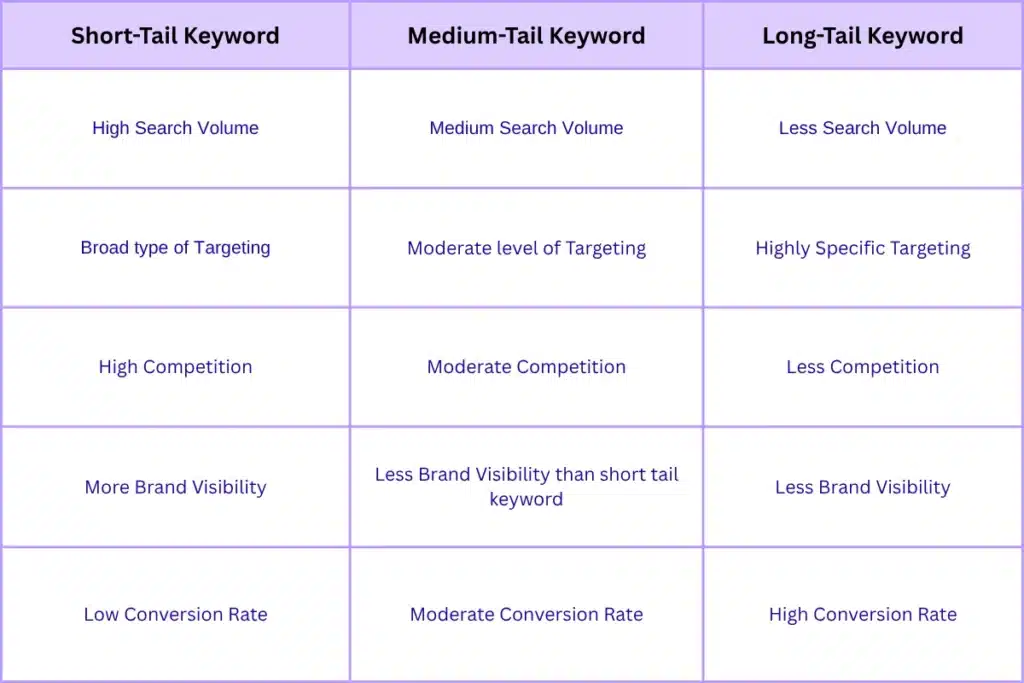
Types of Keywords on the Basis of Intent
Search intent is the reason behind the user’s query.
Here are 3 types of keywords on the basis of search intent’
- Informational Keywords
Informational keywords are used by SEO professionals when they want people to learn or find answers on your webpages.
Examples:
“what is the name of current prime minister of India.”
“how to lose belly fat”
“can i eat rich at night”
Mostly used in :
Blog posts
Guides and tutorials
FAQ pages.
Great for building traffic and authority.
Navigational Keywords
Navigational keywords are used by SEO professionals when they want someone to reach a specific website or webpage.
Examples:
“Instagram login”
“Puma shoes”
“Aadhar card”
Mostly used in:
Brand homepages
Product or service pages.With these keywords, you get ranked on your own brand terms. Whenever people search for your brand, your website appears at the top.
Commercial and Transaction Keywords
Commercial keywords are used by SEO professionals when they target people who are in the phase of researching and considering before buying the product or service.
Examples:
“best shoes for running”
“graphic design course reviews”
“best editing software”
Transactional keywords are used by SEO professionals when they want to target people who are ready to take action or buy a product or service.
Examples:
“order shoes for running”
“buy graphic design course”
“sign up for editing software”
Mostly used in:
Product pages
Comparison pages
Pricing and signup pages.
These keywords are very specific; hence have lower volume but a higher conversion rate.
How to Do Keyword Research as a Beginner
Here is the simple process:
Step 1: Decide your Goals and Audience.
Before keywords, define these things:
- Who will be your audience (beginners, professionals, local customers, etc.).
- What problems you will solve.
- What topics your website covers.
- Write down seed keywords—broad terms related to your niche.
For a salon, seed words could be:
“hair salon”
“beauty salon”
“haircut”
“best salon”
Step 2: Expand Keyword Ideas
Use your seed keywords to generate more keywords:
- Type each seed keyword into Google, look for google suggestions and note them in a sheet.
- Also look for People Also Ask and note them.
- Go for google’s ad keyword plannar and search all seed keywords there, and download all the keywords.
In this phase, our motive is to collect a large number of keywords and place them all in a sheet.
Step 3: Analyse Keyword Metrics.
Check For :
- Search volume
No of times users search for a keyword in a month. Should have at least 100 searches per month. - Keyword difficulty
How difficult it is to rank for the keyword. Tell us about the competition. If new, use low competition keywords. - Search intent
Tell us about the purpose of the user’s query. Informational, navigational and commercial.Sort the keywords related to your website.
Step 4: Content Planning
- Write topics from the keywords that you have sorted.
- Create a content calendar to organise the content.
- Create an outline of the topics.
Step 5: Group Keywords.
- Use related keywords in a topic.
- Choose one primary keyword in the H1 heading and title tag
and some secondary keywords in the Subheading and body text per page.
Create content that clearly matches the search intent.
Important Tools to Use for Keyword Research
As a beginner, your main approach should be to use free tools for keyword research. These tools are great for learning and practising the basics of keyword research.
- Google Keyword Planner
Shows search volume, keyword difficulty (KD) and keyword ideas (in a Google Ads account). - Google Search Console
Provides you with a list of queries in which your website is already ranking. - Google Trends
Shows how the keyword trend is going over a period of time. - People Also Ask and Google Suggestions
Show real questions people ask.
Paid Keyword Research Tools
These contain a full analysis of keywords in depth:
Ubersuggest
SEMrush
SE ranking
Ahrefs
Pingback: What Is SEO In Digital Marketing
Pingback: How Search Engines Work - Crawling To Ranking